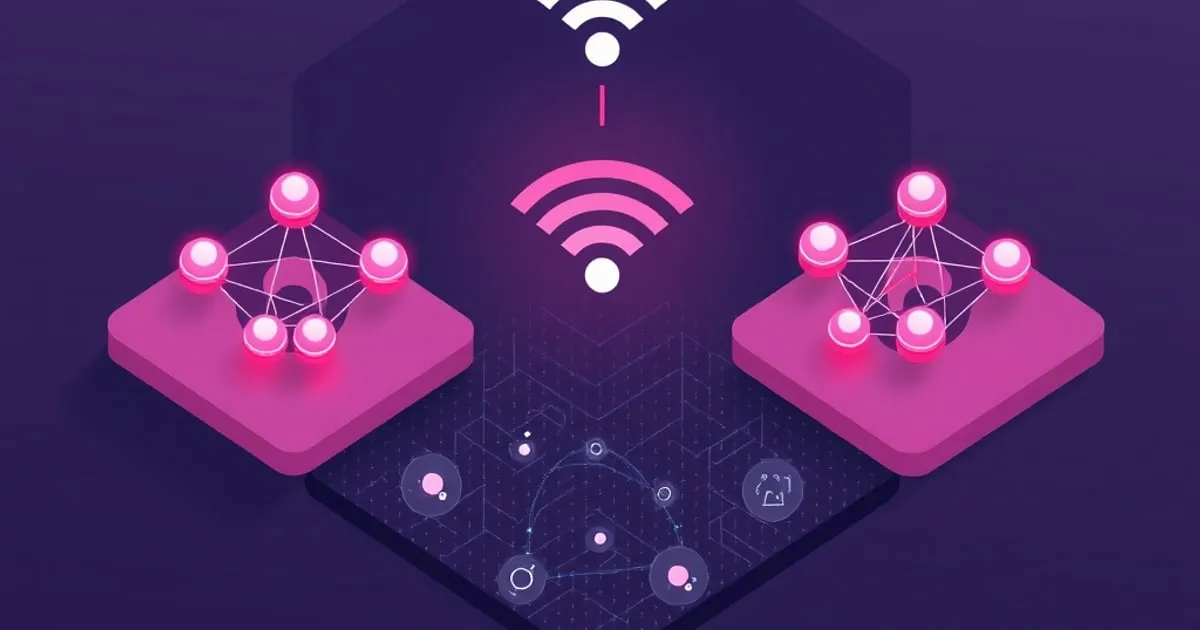
Matter over Wi-Fi vs Thread: Power, Mesh, and Setup
Matter uses the same application layer over Wi-Fi and Thread, while power needs, mesh behavior, IPv6 setup, and border router requirements differ.
The “matter over wifi vs matter over thread” question trips people up because the box says Matter in big letters and the radio in small ones. Both are the same Matter: same controller, same fabric, same QR code pairing, same local control. What changes is the pipe underneath. Thread is a low-power 802.15.4 mesh that needs a border router to reach your LAN; Wi-Fi is the network you already have. The short answer is Thread for anything on a battery, Wi-Fi for anything that plugs in and moves real data, and a border router before you buy a single Thread device.
What “over” actually means here
Matter is an application layer that runs on IPv6. The Connectivity Standards Alliance’s own description is that the protocol “will run on Wi-Fi and Thread network layers and will use Bluetooth Low Energy for commissioning” (CSA). Thread is built on IEEE 802.15.4 at 2.4 GHz with a data rate of “250 kbps” (Silicon Labs), the same physical layer as Zigbee, wrapped in IPv6 so Matter can address every node directly.
From the phone, pairing looks identical. Bluetooth handles the handshake, then the phone pushes credentials. For Wi-Fi that is your SSID and password. For Thread it is the network key, which is why Home Assistant’s docs say “you need a Thread border router near the device and your phone needs to know the credentials of your (newly created) Thread network” (Home Assistant).
Spec table
| Matter over Thread | Matter over Wi-Fi | |
|---|---|---|
| Radio | IEEE 802.15.4, 2.4 GHz | 802.11, 2.4 or 5 GHz |
| Data rate | 250 kbps | Tens to hundreds of Mbps |
| Topology | Self-healing mesh, up to 32 routers, 511 end devices per router | Star, every device talks to an AP |
| Extra hardware | Thread border router | None beyond your AP |
| Battery devices | Designed for it (Sleepy End Devices, Matter ICD) | Rare; sleep behaviour set by the AP |
| Addressing | IPv6 only, via the border router | IPv4 and IPv6, but Matter needs IPv6 working |
| Best for | Sensors, buttons, locks, bulbs | Plugs, appliances, cameras, anything with a cord |
Router and end device counts are from OpenThread’s primer: Thread “tries to keep the number of Mesh Extenders between 16 and 23” with a hard limit of 32, and allows “511 per Mesh Extender” (OpenThread).
Where Matter over Thread wins
Power is the whole argument. A Thread Sleepy End Device is “normally disabled, wakes on occasion to poll for messages from its parent” (OpenThread). The radio is off most of the time and the parent router holds its mail. A Wi-Fi radio holding an association to an access point cannot do that.
Matter formalises this as Intermittently Connected Devices. Silicon Labs splits them into Short Idle Time ICDs, “battery powered devices that can always be reached by clients” such as door locks, and Long Idle Time ICDs, “battery powered devices that require synchronization between the client and the ICD for communication to succeed,” with sensors as the example (Silicon Labs). Matter 1.4 added the Long Idle Time protocol and a Check-In Protocol “to ensure reliable communication for low-power devices” (CSA).
The mesh is the second win. Mains-powered Thread devices become routers and forward for their neighbours, and the network re-elects a leader if one dies. One Thread bulb in the hallway fixes the dead spot at the far bedroom; the Wi-Fi equivalent is another access point. Third, 30 Thread sensors take zero client slots and zero airtime on the Wi-Fi your laptops share.
Where Matter over Wi-Fi wins
No border router. Google’s guide is explicit: “If the Matter-enabled smart devices in your home only use Wi-Fi to communicate,” any Matter hub works, including older Nest speakers with no Thread radio (Google). One plug plus a Home Assistant box is the whole setup, and control stays local: Matter devices “carry out your commands over your existing home network versus communicating over the internet.”
Bandwidth. 250 kbps is fine for on, off and 21.5 degrees. It is not fine for a video doorbell or a firmware image. Devices that move data are Wi-Fi devices.
Wi-Fi’s battery problem is structural. On Thread the device controls its own polling interval. On Wi-Fi it does not: “Wi-Fi polling configuration are dictated by the Access Point and cannot be changed at the Matter level” (Silicon Labs). A battery Wi-Fi sensor lives at the mercy of your AP’s beacon and DTIM settings, which is why the category barely exists.
The border router tax, and what Matter 1.4 does about it
A border router provides “Bidirectional IP connectivity between Thread and Wi-Fi/Ethernet networks” plus service discovery “via mDNS (on a Wi-Fi/Ethernet link) and SRP (on a Thread network)” (OpenThread). Without one, a Thread device is on an island. Apple spells out the consequence: with no Thread-enabled home hub you cannot “use automations, get notifications, or remotely-control your Thread-based accessories” (Apple).
Border routers you may already own: Apple TV 4K (2nd gen, or 3rd gen Wi-Fi + Ethernet), HomePod mini, HomePod 2nd gen; Nest Hub 2nd gen, Nest Hub Max, Nest Wifi Pro, Google TV Streamer 4K; Home Assistant Yellow or a Connect ZBT-1/ZBT-2 flashed for Thread. The catch: “Each vendor forms their own Thread network when you start using their products,” so a HomePod, a Nest Hub and an HA dongle can produce three meshes that do not forward for each other (Home Assistant). One HA-specific gotcha: OTA updates of Matter devices from Home Assistant “are not supported with an Apple Thread border router.”
Matter 1.4 is the standards body’s answer. Home Routers and Access Points (HRAP) are certified devices “combining both a Wi-Fi access point and a Thread Border Router,” with “a secure directory for storing and sharing Thread network credentials” so new border routers join the existing mesh “rather than creating new ones” (CSA). When your Wi-Fi router is also your border router, the tax disappears. A router with a Thread radio is not automatically an HRAP; check the CSA product database. Placement and count: our border router guide. The layer model: how Matter, Thread and border routers fit together.
Requirements both transports share
Both need IPv6 on your LAN. Thread is “an IPv6-only protocol” and the Home Assistant host “must have working IPv6 connectivity” (Home Assistant), and Wi-Fi Matter devices rely on IPv6 link-local addressing and mDNS too. Controller on one VLAN, devices on another, no mDNS reflection: that is most of our Matter pairing failures post, not the radio. Both support multi-admin, with each device expected to “at least support 5 different fabrics simultaneously,” so one lock can sit in Apple Home and Home Assistant at once. And both put IP hosts on your network; a Wi-Fi Matter plug shares a segment with your laptop unless you VLAN it, a problem techsentinel.news tracks across IoT vendors.
What to actually buy
- Starting from zero with Home Assistant on a mini-PC: a Connect ZBT-2 as border router, Thread for every battery device, Wi-Fi for plugs and anything with a camera. One mesh, one vendor.
- Already own an Apple TV 4K or HomePod mini: you have a border router. Buy Thread sensors and locks, pair in the Home app, share to Home Assistant as a second fabric, and accept that HA cannot push firmware over Apple’s border router.
- Three mains devices and no plans to grow: Wi-Fi. Skip the border router and stop reading comparison posts.
- Mixed Apple and Google hubs: pick one vendor’s border routers as the Thread network and treat the other as controller-only, or sensors will drop when the wrong hub reboots.
The device-by-device version of this call is in Thread vs Wi-Fi smart home devices.
Related across the network
- Zigbee vs Z-Wave vs Thread: Which Mesh to Build — homeassistanthq.com
- Home Assistant Hardware: What to Run It On — homeassistanthq.com
- Home Assistant OS vs Container: Which Install Method to Pick — homeassistanthq.com
- Zigbee Devices Going Unavailable: How to Fix It — homeassistanthq.com
- MikroTik CAPsMAN Setup Guide for RouterOS 7: Controller, CAPs, and VLANs — mikrotikguide.com
Sources
- Connectivity Standards Alliance: Matter 1.4 Enables More Capable Smart Homes
- Connectivity Standards Alliance: Matter
- Google Home Help: Prepare your smart home for Matter
- Apple Support: If you see a 'Thread Border Router Required' alert
- Home Assistant: Matter integration
- Home Assistant: Thread integration
- OpenThread: Border Router
- OpenThread: Node Roles and Types
- Silicon Labs: Matter Intermittently Connected Devices (ICD)
- Silicon Labs: Thread Technology Overview
Related

Thread vs Wi-Fi for Smart Home Devices
Battery sensors and locks favor Thread, while cameras and displays favor Wi-Fi; the comparison covers power, bandwidth, mesh design, and infrastructure.

How Many Thread Border Routers Do You Need?
A single Thread border router connects the mesh, two on the same network add resilience, and additional units should address verified coverage gaps.

How to Add a Matter Device to Home Assistant
The guide covers Wi-Fi and Thread prerequisites, companion app commissioning, multi-admin sharing, credential syncing, and common network failures.